


Life Begins again.

To my new heart
You have arrived and have saved my life,
We will be together for the rest of time
Thanks to the donor family for my life
We will go on this journey together
You and me unknown
You have made me warm and added colour
You have allowed me to walk and breathe again
I can do things I could not do, thanks to you
I can plan and look forward, learn some more
So much still to do, unknown
I will treat you well, look after you
Together we will find the way forward
I will listen to you, you will guide me
I will train you, take my meds
Stronger we will become into the unknown
Both of us have faced death in our own way
The support and guidance I received and
The decision your family made together
Meant we didn’t arrive at that place
Yet put together we could go into the unknown.
We know we will be around for a while
Loving my wife, family and friends
Enjoying life and what it brings
Avoiding negativity, do something special
The known is we have life together you and me.
During this time it was the 50th anniversary of the first Heart Transplant on Dec. 3, 1967. The first patient, Louis Washkansky, a 55-year-old grocer, received the heart of a young woman who had suffered brain damage after being hit by a car. Mr. Washkansky lived for 18 days after the procedure, succumbing to a lung infection after his immune system was apparently weakened by drugs to prevent organ rejection. On the anniversary I was 10.5 weeks post-transplant.
Today, with the refinement of drugs that help prevent the body from rejecting the foreign organ, the long-term outcomes following heart transplantation are excellent. About 85 percent of patients live for at least a year after the procedure. The median long-term survival is probably greater than 12 years, and it’s about 14 years if the patient survives the first year. Each day my chance of survival increases.
Though heart transplants have saved many lives, many more continue to be lost while patients wait for a viable organ. Only about 3,000 Americans, 1,500 Brits, 50-80 Australian’s and up to 20 New Zealander’s receive a heart transplant each year. Despite public campaigns to increase organ donation, the number of available organs has remained relatively constant over the years. (That’s partly good news) As a result, a heart transplant can seem as much like a lotto ticket as a medical option. A heart transplant is the answer to heart failure the way the lottery is the answer to poverty”

I am fortunate to have been so ill during the year that the most transplants have been performed in New Zealand's history.
So it was on the 3rd of November we moved back home from Hearty Towers for good. This was filled with both excitement and trepidation for both of us. On the one hand we would be in our own home, our own bed, have all our things about us, could have Goggles (our cat) home. Goggles is a lovely but

shy and skittery Ragdoll. He is getting better and loves to be around us, but of course he had to go to a cattery during my stay in hospital, so we weren’t sure how he would handle it. I called several times and they said he was OK. When we arrived he was sitting on a pole in the highest position within the cattery, looking down over the room and the other cats. As soon as he heard us he looked round and got excited. It was so lovely, he snuggled into my hands and cuddled up when I picked him up. When we got home he was out the door and into his hiding place, sadly we left the cat door unlocked. He eventually came back inside and settled down. It was a lovely reunion.
The next day the Auckland Central Masters Swimming Harbour Series had the first event, the Herne Bay / Watchman’s Island swim. Pauline had stepped in and helped organise the event as I was unable to help out. It was nice to go and watch the swimmers finish and then onto the prize giving. I was able to mingle with swimming friends that I hadn’t seen since last summer, they were all thankful for me and wished me all the best, most were surprised to see me so quickly. It was so nice to be able to see Pauline swimming again and look forward to joining her again one day.
That night we went to the concert of Stairway to Heaven that I mentioned in the last blog, and I walked up One Tree Hill the next morning. So we had a big first weekend at home, diving into life at a rate faster than expected. It was good in a way because we had concerns at coming home. We no longer had the immediate support of others close at hand, if we needed assistance or advice now the phone was the only way to get it. We had to travel to rehab, clinics and tests. It was a bit like been taken off all the lines, tubes and machines I was on, now we were on our own, (kind of). What happens if something goes wrong or we need immediate assistance? Well the answer was we are like everyone else, all the well people, get used to it.
I got to go to my first Breakers game (Basketball), as we had got season tickets to tempt fate. Others had got enjoyment going for me while I had watched the games on TV, so it was

nice to go along in person and enjoy the experience again, one I thought I may not get to do again. Pauline emailed the club and told them what had happened to me and they invited us to a training


session. So off we went. I used to play basketball during school and a few year after until I got too small and perhaps a bit slow. The Breakers invite schools along to their
training sessions and do some work with them. Who should be there that day but the Rutherford College team, where I had gone to school and played to win a championship in 1972. What a blast.
We got to watch the team play their annual game of cricket

and see their competitiveness and team spirit at its best, behaviours that can only be developed in a true team. It made a

nice step, I could imagine getting fit again, I tried to throw a basket from the keyhole, I used to be able to hit 3 pointers with relative ease, but this time the ball simply plopped , didn’t reach the hoop and I had no strength to throw the ball let alone drop a basket. Gave me a lesson in how much there is to do.
We have visited my Mother (Lois) a number of times. She is in early stage of dementia, she can sometimes be more lucid than other times. I am so grateful that she didn’t have to see

me pass away and deal with that too. For those who experience this situation it is really hard to see the person who nurtured you, feed you, helped you, cared for you deteriorate and become a shell of their former being. It gives me insight into how my close ones must have experienced my decline and how it must have felt for them. I have learnt that one must be present for them, be there and not judge them or try to get them to be normal.

I always take photos, either on the computer or the phone for her to look through, it seems to help her, makes us laugh
together and share memories that can only be contained within the picture now for her, it seems to help create the story for her, even if we have the same conversation 5 or 6 times over a single visit.
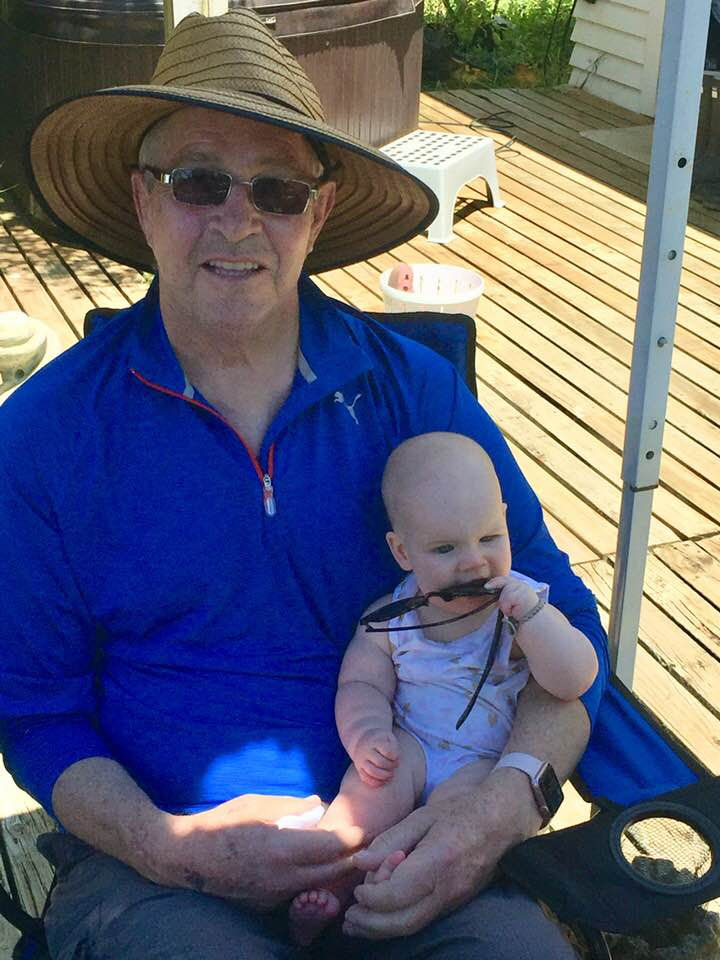
I have spent time with family and enjoyed the new members Addison and Vinny, my sister’s Grandchildren. We went to the baby shower of my niece, who is giving my other sister
the pleasure of Grandparenthood in early 2018. We took my Grandchildren to Peter Pan, a

musical, and had a lovely time with them. We have been to a BBQ with my brother and his family and spent time with my father. We have been a little busy.

We decided to purchase a motorhome, we had hired on during our visits to the UK. It has just arrived, we have now test driven it and signed on the line, it will be ready sometime in January for us to take possession, once it is fully converted to NZ standards. It will provide us with a new normal.
My focus has been on getting fit and starting to do normal things. It is frustrating being well but inhibited by not being able to lift and move things about due to the healing of the breastbone (sternum) and associated muscle damage. It will take at least 3 months and up to 6 months to completely settle down.
We began a rehab program in the Gym on the first day at Hearty Towers, we had a daily visit to the Gym Monday to

Friday. We also had other appointments, tests poke and prods to attend during the week. These reduced week by week, however the daily visits to the gym increased in intensity as we went along, at the beginning I was unable to walk back afterwards, as time went on it all got more manageable, the number of repeats increased and the weights got heavier and I got stronger and better.
The first 3 months following a transplant are the most important in terms of physical recovery, properly true of any major surgery. As I have said before each person is different, both the story and journey is individual. I have been fortunate that my recovery has been quick, sometimes I think too quickly, I am able to do things that maybe I should not be doing. I have torn a muscle in my chest due to the weight and / or movement, most likely the combination of both. It has hurt like hell, at one point I thought we might need an Ambulance, I checked in with the Transplant Co-ordinator, they told me what to take some pain killers and see how it went. I was subsequently referred to the surgery team who confirmed the torn muscle in my chest. So I have reduced the weight and movement to let it heal.
It has been interesting exercising with a heart that does not increase in relation to the workload. It has been like driving a car with a governor on, the speed is held to a certain limit. During exercise as you increase in time and effort your heart rate increases, a normal person has a maximum heart rate. A simple manner to work that out is take 220 subtract the age of the individual and you get a rough idea of the Maximum heart rate. So in my case it would be 220 – 62 = 157. Whilst this a crude method it provides some insight. Exercise should be somewhere in the range of 50 – 80% of the maximum heart rate, so for me it would be 80 – 130.
Due to going into AF (atrial fibrillation) I was placed on a beta blocker (Sotalol). It causes a decrease in heart rate and a limited reduction in the force of contraction of the heart. There

is a reduction in cardiac work and in oxygen demand. Sotalol does not decrease blood pressure. Which means that my heart rate is reduced while on this drug. During exercise my Heart Rate would not go over 100 and often it was hard to get it up in the 90’s, this limited the oxygen going to the muscles under workload, therefore I would run out of gas during the exercise, and not able to continue at a reasonable level to build fitness in the aerobic zone, thus building endurance was difficult.

I have recently been taken off Sotalol and have in less than a week been able to increase my output on the bike by over 13% with the heart rate now getting up to 120 without any effect. I am sure in time it will behave normally and I will be able to exercise with a heart rate close to normal. That is all very technical (and probably boring stuff), but important to me to understand how my body is performing and the changes and adjustments I need to make to live as normal a life as possible, and particularly if I wish to go back to some form of competition, like the transplant games in 2019.
tcompetition, like the transplant games.
Comments